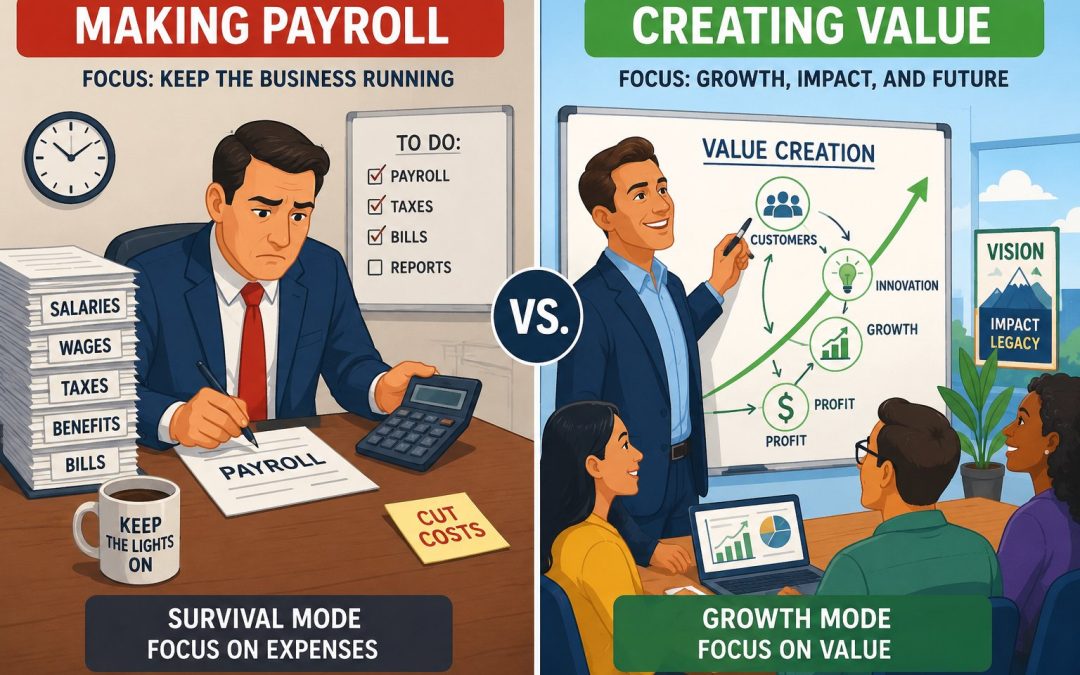
Most owners know how to run their business to consistently make payroll. However, the creation of a sustainable business that buyers want to buy is a much rarer achievement than you think.
McKinsey published a white paper in February which highlighted some stunning facts.
Talking about an aging population they stated:
This shift has far-reaching implications for business ownership. Today, more than half of all small-business owners in the United States are over the age of 55—up from roughly 30 percent in 2002. One in four small-business owners is 65 or older. This aging cohort represents approximately 1.5 million firms across the country, with baby boomers alone owning nearly a quarter of all small businesses, about double the share held by their predecessors two decades ago.
And a stat that surprised me and I’ve seen a lot of entrepreneurial stats over 40 years.
Despite the economic value embedded in many small businesses, closure—not continuity—is the dominant exit path today. In 2022 alone, we estimate that 510,000 SMBs exited the market. Ninety-two percent of those exits occurred through closure, 5 percent were completed as sales, and 3 percent transferred to new owners (often intergenerationally to family members).
So as the owner of a private company the questions become:
- Are you building a business buyers will love? (even if you keep it)
- Are you creating shareholder value?
- Are you scaling not just growing?
- Do you really understand the way a buyer thinks?
We say:
Value isn’t created at exit, it’s exposed.
We also say valuation follows a simple rule:
Buyers perceive value. Sellers aspire to price.
After 40 years up close to driving value as public company leaders, investment bankers, private company owners, both Kevin and I believe there is a simple methodology that owners are failing to use.
Look through the lens of a buyer. Teach yourself how a buyer thinks.
- What are the attributes that buyers cherish?
- How do they mitigate risk?
- Why are they buying what they are buying?
- Why does dependency scare them?
- Who will run this target once we own it?
To help owners really assess their business against a buyer’s set of filters, we ask them to test themselves.

Over the last 25 years, no company has scored higher than 60.
What does that mean?
Well clearly some scores are very low and some are high. An average of 2.5 out 5 would only get you to 37.5.
Low scores around dependency are killers not discounts, meaning buyers tend to walk.
A low score around your positioning may mean you are on an inevitable decline. As Seth Godin would say. You are either Invisible or Remarkable.
How do I scale my business to increase my scores?
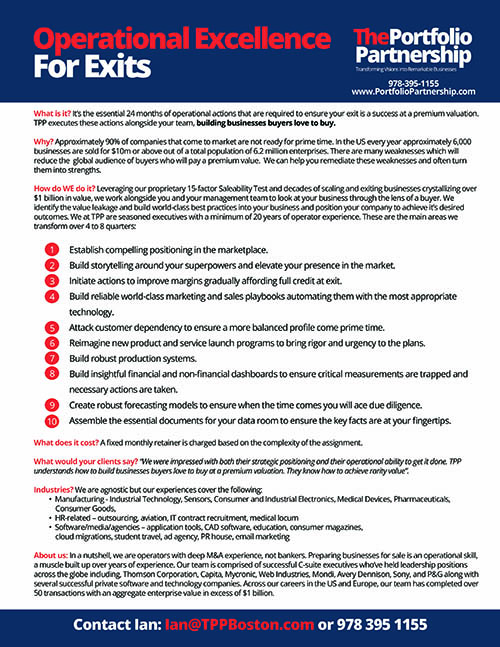
If you have done a thorough assessment of your business using our test (of course we do these for a reasonable fee, in around 4 weeks and we call it Phase 1) then you have something in your hand that is valuable. You have a blueprint for success with operational priorities staring you in the face.
If we are invited to help. We fix low scores – we call it Phase 2. Sometimes 18 months ahead of an exit. Sometimes just to scale a safer business that is much more fun to run and that is building rarity value.
When working on Phase 2, to execute the operational priorities stemming from the Saleability Test we embed our SEG operating model. Strategy, Execution, Governance. But of course you could embed the same model with no help. It’s just a better way to scale. Here is the visual illustration of the model.


Now it’s worth pointing out that this is not a won and done model, because that’s not how life works. This is a continuous improvement model because business is a contact sport. This model creates a symbiotic relationship across all three pillars.
Think your sales team sucks? Maybe it’s your Governance model, specifically perhaps your commission structure. It might be your weak sales process captured in a badly written playbook.
Some scores take longer to fix. Succession planning is a tough one, but it must resolved if the business is still owner dependent.
Customer concentration is another tough one. At best there will be some discounting by buyers to mitigate risk. But forget buyers. It’s just damn risky for the health of your business to have 30% of your business in one customer’s hands.
As you look down your scores you can see those that have a higher priority and some that are quite good and frankly improvements can be delayed.
The Key Takeaways
By assessing your business through a buyer’s lens, you are able to assess priorities, establish a blueprint for success and take advantage of a compelling Operating Model like SEG above. The takeaways are clear:
- Execution always aligned to strategy
- What gets measured gets done
- Initiatives are focused on value creation
- Cadence of activity respects “Pace and Space”
- Talent has purpose, autonomy and accountability
- Business scales safely
- Visions are transformed into remarkable business.
I hope this paper sets out an attractive way of scaling your business and inspires you to accelerate value creation to deliver a fun place to work and a sustainable business to manage.
Detailed suggested solutions can be found on our website.
Ian@TPPBoston.com