Selling to management may be the obvious choice for service based businesses eg marketing agencies, residential architecture firms, managed IT services, engineering practices etc.
However these are particularly tricky transactions to execute. One main reason being that the management team is acquiring the business from their boss or certainly the main partner.
Every MBO is illustrated visually by the triangle of power dynamics.
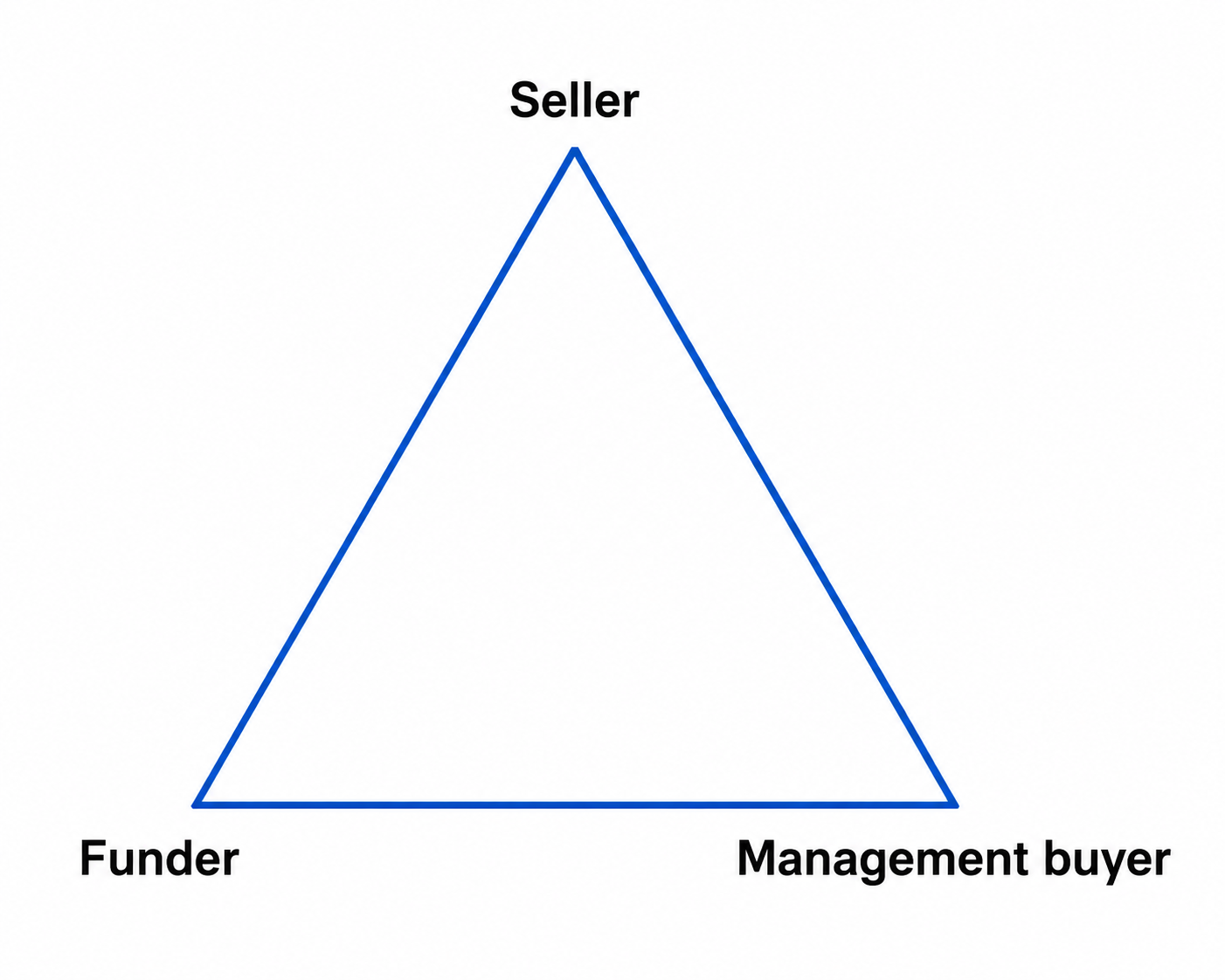
All three points of the triangle need to understand each other for a deal to close.
I’ve set out below a process map to guide both the seller and the buyer.
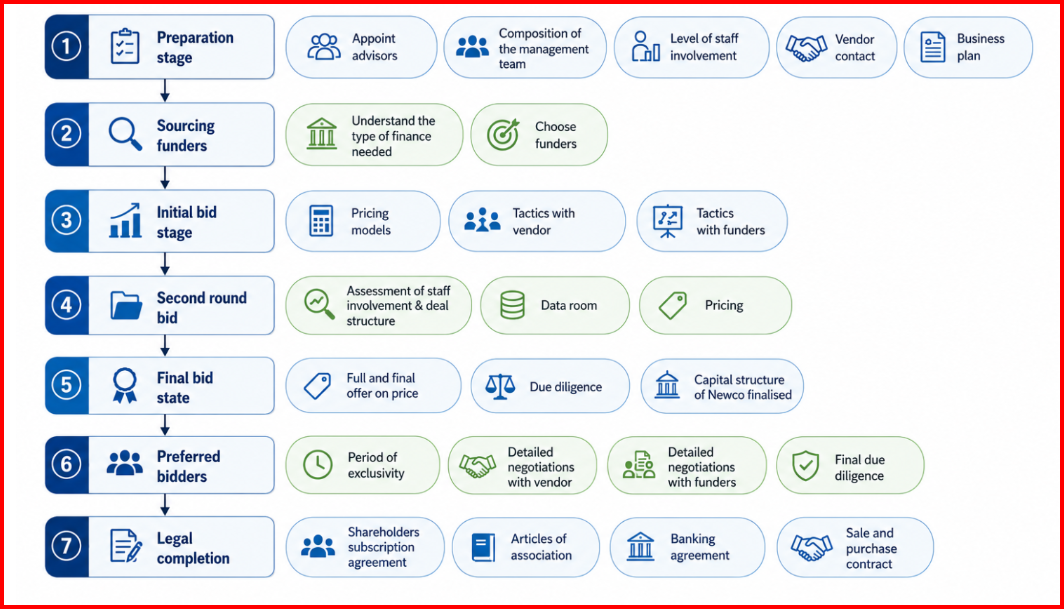
Preparation Stage
The preparation stage is key to the success of the management buy-out. It may become obvious during this stage that an MBO is not feasible. Equally it is a time for the management team to articulate their plans, understand the timetable of the seller and prepare themselves for raising the money.
The amount of work to be completed will depend on the approach taken by the seller. The seller can take four basic approaches:
- No auction, one to one deal with management and a minimum acceptable price.
- As in 1. but with no price given.
- An auction process with a minimum price given (unlikely).
- An auction process with no price given.
For the purpose of explaining the various stages let us assume the most complex model, namely 4. above, an auction process with no price given by the seller.
Appoint Advisers
On the obvious assumption that the head of the MBO team has the approval of the seller to stage an MBO then the first stage should be to approach advisors. The cynic may claim that the author as an MBO advisor would of course suggest this approach. However, the case for appointing advisors is compelling. Management have a business to run at the same time as completing one of the most complex corporate transactions they will encounter.
Composition of the Management Team
Who is to be included in the management? Each sector demands a slightly different mix of skills but financial backers to the team will expect to see a minimum range of skills. Leadership, operational, finance and marketing are probably the core skills. However, in some sectors, IT, personnel and engineering experience may be imperative.
Financial Institutions will expect the managing director heading the MBO to have a clear vision of the composition of his team.
Level of Staff Involvement
There is no correct answer.The best advice to MBO teams is probably to delay the decision of staff involvement to the later stages of the process.
Again, financial backers will often look to the MBO team to suggest the level of staff involvement. Demonstrably, in a business which relies heavily on a large number of staff to deliver the service directly to the customer then perhaps an Employee Share Ownership Plan is appropriate. The balance to be struck is to ensure that the MBO team have control over the company (operationally if not through voting control) whilst motivating the relevant staff to deliver a first class service.
Seller Contact
Management must remember when dealing with their employers, the seller, that the deal may not happen and therefore serious disagreements should be avoided! Assuming an auction process, it should be possible for the management team to understand the seller’s agenda much better than the other bidders. The downside for the management team is that the seller’s aspiration on price may be outside the affordability range of the MBO model. MBO teams should establish a sensible timetable with the vendor as soon as possible and attempt to influence the timetable to their advantage.
Business Plan
An essential output of the preparation stage is the business plan. The precise elements are described later but the essence is the production of a document that sells the opportunity to investors, illustrates the strength of the business within its market, describes the quality of the management team and articulates a believable growth strategy.
Therefore the management team with the assistance of their advisors will now be clear on the type of finance required, the composition of the management team (or, of course, obvious gaps in the management team) and the growth path that is possible from the MBO business.
The management team are now ready to consider appropriate funders.
Sourcing Funders
Thus the third element of the MBO triangle comes into play – the money men. The three basic sources will be considered: equity capital, mezzanine capital and bank debt.
The timing for choosing your preferred funders relative to pricing the bid is not easy. There is a temptation to run with equity or bank players as backers to get through the initial bidding rounds instead of choosing one preferred lead funder to support your bid.
Initial Bid Stage
Assuming a competitive auction process the vendor will set a deadline to receive initial offers. Precise instructions will be issued by the seller, regarding their requirements covering, price, staff plan, strategy for the business, ability to fund the offer and conditions attaching to the offer (these requirements will vary considerably depending on the specific circumstances of the deal eg an owner of a private company selling to his management team will mainly be interested in the ability of the offer to be funded).
The key areas therefore worth exploring in detail are: pricing models for MBO teams, recommended tactics at this stage of the process with the seller and how to deal with your funders.
Further Bidding Rounds
As mentioned earlier, the number of bidding rounds will depend on the tactics of the seller. The diagram above indicates three rounds which is common in auction processes.
Preferred Bidder
Assuming a successful outcome, the final stages of this complex process will see the MBO team selected as the preferred bidder. It is likely at this stage that final negotiations will be conducted by the MBO team and their advisors with both the seller and, separately, with the financial backer to finalise terms.
Due diligence will have been an on-going process conducted by the preferred lead funder but it is likely that only at this preferred stage will the seller give permission for the funder to complete due diligence.
Thus even at this late stage it is possible for the preferred funder to pull out because of facts uncovered in their investigations into the business. It is therefore imperative for MBO teams to ensure that funders are not surprised by these final investigations.
Legal Completion
As in all corporate transactions there is a need for all aspects of the deal to be legally documented. The key elements include the Shareholders Agreement, Articles of Association, Banking Agreements and the agreement between buyer and seller – namely the Sale and Purchase Contract.
I hope that gives a good overview of what is involved.
Reach out to to talk through your MBO opportunity and the questions worth considering before going too far!
Ian@TPPboston.com