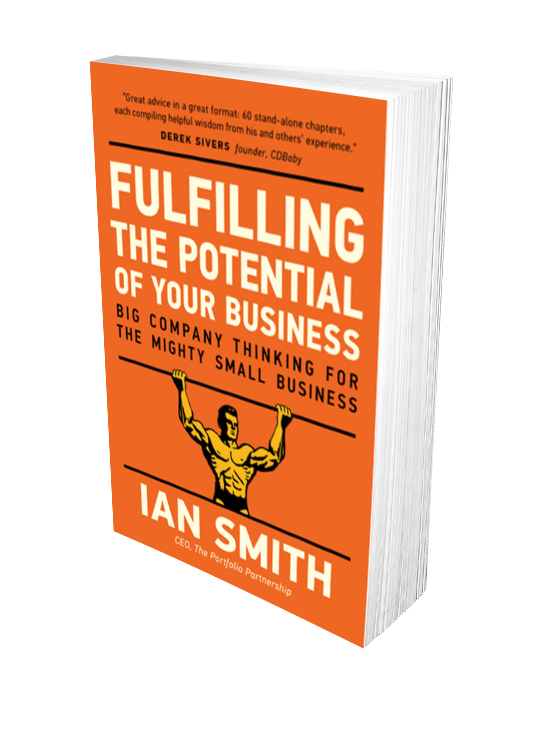

This is a practical briefing aimed at private company owners, CEOs, CFOs, and the trusted advisers around them. It is also delivered as a keynote or workshop event.
The Big Idea: Flip the Lens
Most owners have spent a career looking out from inside the business — at customers, competitors, the next hire, the next quarter. A buyer does the opposite. They look in, coldly, asking one question over and over: what could go wrong with this, and what will it cost me to fix?
“Would You Buy Your Own Company?” simply hands the owner the buyer’s chair for ninety minutes. It is not a valuation exercise dressed up as theatre, it is a discipline. When you adopt the buyer’s lens early, you stop running the business for this year’s profit and start running it for its transferable, de-risked, premium-priced value. The gap between those two ways of running a company is, quite literally, money.
Value isn’t created at exit, it’s exposed.

The Mindset Flip: From Seller to Buyer
Imagine the business next door that is identical to yours in every way, comes up for sale tomorrow. Same revenue, same customers, same team, same reliance on its owner. The bank will lend you the money. Would you buy it? And if the answer is no way! Why would a real buyer pay you what you aspire to?
This is the emotional pivot required of most owners. Most owners have never seriously asked it. They assume their business is valuable because it is theirs, because it is profitable, because it has survived. A buyer assumes nothing. A buyer prices risk.
The things that make a business comfortable to own are rarely the things that make it valuable to sell. An owner who is indispensable, a handful of loyal flagship customers, undocumented know-how living in people’s heads. These feel like strengths from the inside and read as liabilities from the outside.
How a Buyer Actually Values You
Buyers do not value effort, history, or potential they cannot see. They value sustainable earnings, and they multiply those earnings by a number that reflects how safe and scalable those earnings are.
Enterprise Value = EBITDA × Multiple
Assuming there is a strategic fit. Assuming what you do satisfies the buyer’s strategic gap then it will come down to two levers.
Two levers move enterprise value, and a serious owner works both at once:
● The EBITDA lever — grow sustainable, defensible earnings (pricing, product mix, efficiency, a lead generation engine, a real sales engine).
● The multiple lever — earn a higher multiple by de-risking the business: recurring revenue, customer diversification, a management team that runs it without you, clean and credible numbers, an operating model that’s scaleable. There is gold in the ground to take the business to the next level.
The second lever is the one owners ignore — and it is often worth more than the first. Most privately held companies trade somewhere in the 4x–6x EBITDA range, but the spread within any sector is enormous. Two companies with identical profits can be worth double or half of each other purely on the quality and durability of those profits.

“A dollar of profit is not worth a dollar. In a fragile, owner-dependent business it might be worth four dollars of enterprise value. In a clean, diversified, self-running business the same dollar is worth six, seven, eight. So the question is never just ‘how much do we make?’ It will always be ‘how much would a buyer trust the dollar we make to keep arriving after we’re gone?
Buyers perceive value. Sellers aspire to price.
The Buyer’s Diligence Lens: What Quietly Destroys Value
To identify these risks and to assess how a buyer thinks we use our The Saleability Test™. This is our proprietary diagnostic tool we have refined over decades from our experience as investment bankers and operating partners sitting on the buyer’s side of hundreds of transactions. It measures 15 value drivers. These are the criteria a sophisticated buyer or investor evaluates when deciding whether, and how much, to pay, or even whether it’s worth proceeding at all. Each is scored 1 (bad) to 5 (great), giving a total out of 75.
The essence of the test is one word: dependency. Buyers do not like dependency — on the owner, on one customer, on a supplier, a coder, a geography, or a product. Dependency kills deals. Every low score is a dependency or a risk the buyer will either price against you or walk away from.
Workshop version
We run this test live with a room full of owners and it always produces surprises. We role play as an objective buyer interviewing the owner as the seller. This is where “would you buy your own company?” starts to become a wake up call.
The Fifteen Value Drivers
These are key ones. They are not in any particular order except POSITIONING is the most important. Who you are is what you build, is what you measure and is who you recruit.
1. Market Positioning — How clearly differentiated is the business from competitors in value proposition, brand perception, or customer experience?
2. Owner Dependency — How much does day-to-day success rely on the founders or key individuals? Would the business run smoothly without them?
3. Sustainable Profitability — What is current annual EBITDA, and how predictable are those profits over the next 2–3 years?
4. Defensible Moat — What protects the business from new entrants or rivals — IP, brand loyalty, scale, or regulatory barriers?
5. Growth Trajectory — What has the 3-year revenue and EBITDA CAGR been? Is growth accelerating or plateauing?
6. Customer Revenue Concentration — What share of revenue sits with the largest customers? Is it well-distributed enough to survive losing one?
7. Industry Growth Rate — How fast is the industry growing over the next 3–5 years, and how well is the company positioned to capitalise?
8. Legacy Product Dependency — What portion of revenue comes from outdated or declining products, and what’s the risk in that dependency?
9. Leadership Quality — Are senior leaders high-performing, experienced, and capable of driving growth — with or without the founder?
10. Organizational Culture — How strong is culture in engagement, retention, values alignment, and adaptability through change?
11. Technology & Systems — How modern, scalable, and integrated are the technology systems supporting current and future operations?
12. Recurring Revenue Model — What portion of revenue is contracted, subscription-based, or otherwise highly predictable year over year?
13. Financial Health (Balance Sheet) — Is the balance sheet strong enough to support growth — low debt, ample cash, healthy working capital? Any red flags?
14. Legal & Compliance Risk — Any outstanding lawsuits, IP disputes, or compliance issues that threaten an acquisition or operations?
15. Process Maturity & Standardization — How clearly defined, repeatable, and documented are the key processes across sales, finance, and service?
What Your Score Tells You
Tally the total out of 75. Most owners land in the middle on a first honest pass and that is exactly the productive discomfort the test is built to create.
Saleability Test™ — Interpreting the Score (out of 75)
Total score
- 65+ Highly saleable business. Competitive interest, premium multiples, clean deal structure. However if owner dependency is low and or customer concentration you may be disappointed with the deal.
- 46–64 Quality business with grooming issues. Interest at a fair price, but negotiation on the risk items.
- 30–45 Good business, but real problems to fix. Probably not saleable. Significant price haircut, earn-outs, or walk-away risk.
- Below 30 Fundamental issues eroding value. A deal is unlikely, or available only on predatory terms.
Most owners we work with score themselves somewhere in the 35 to 55 range on the first honest pass. That is not a failure, it’s a diagnosis. Every 1 or 2 on any of these 15 drivers is a specific, fixable initiative that moves your EBITDA, your multiple, or both.
Closing the Gap: The Value-Creation Agenda
The discipline that turns a score into a plan is prioritisation by EBITDA impact: rank every initiative by the value it will create divided by the time to its first impact. Do the things that move the number soonest, first. Use the cash they generate to fund the next tier.
The table below walks through all fifteen drivers in order — so wherever your low scores fall, you can read straight across from symptom to exit-ready target to the value lever it pulls.
From Low Saleability Score to Value-Creation Workstream

Operator Tip
You will not fix everything, and you should not try. Look at your three lowest Saleability Test scores. Rank them by one number: the EBITDA each fix creates, divided by how long until it starts creating it. Fund the fast, high-impact moves first, let them throw off cash, and reinvest that cash into the next tier. That is how you turn an overwhelming scorecard into a sequence and a sequence into a saleable business. Even if you keep it.
The 18–36 Month Runway
The owners who get premium outcomes started two or three years early, when they had the luxury of fixing things on their own terms. But it is never too late to transform your business and accelerate value creation.
Where The Portfolio Partnership Fits
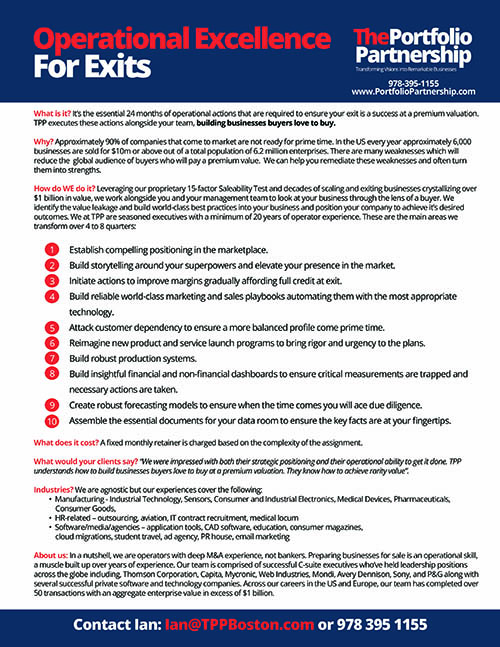
The Saleability Test™ is where every engagement with The Portfolio Partnership begins. We built it from decades on the buyer’s side, across more than 50 deals and over $1 billion in value created. The gap between what an owner thinks their business is worth and what a buyer will pay almost always traces back to the same 15 value drivers.
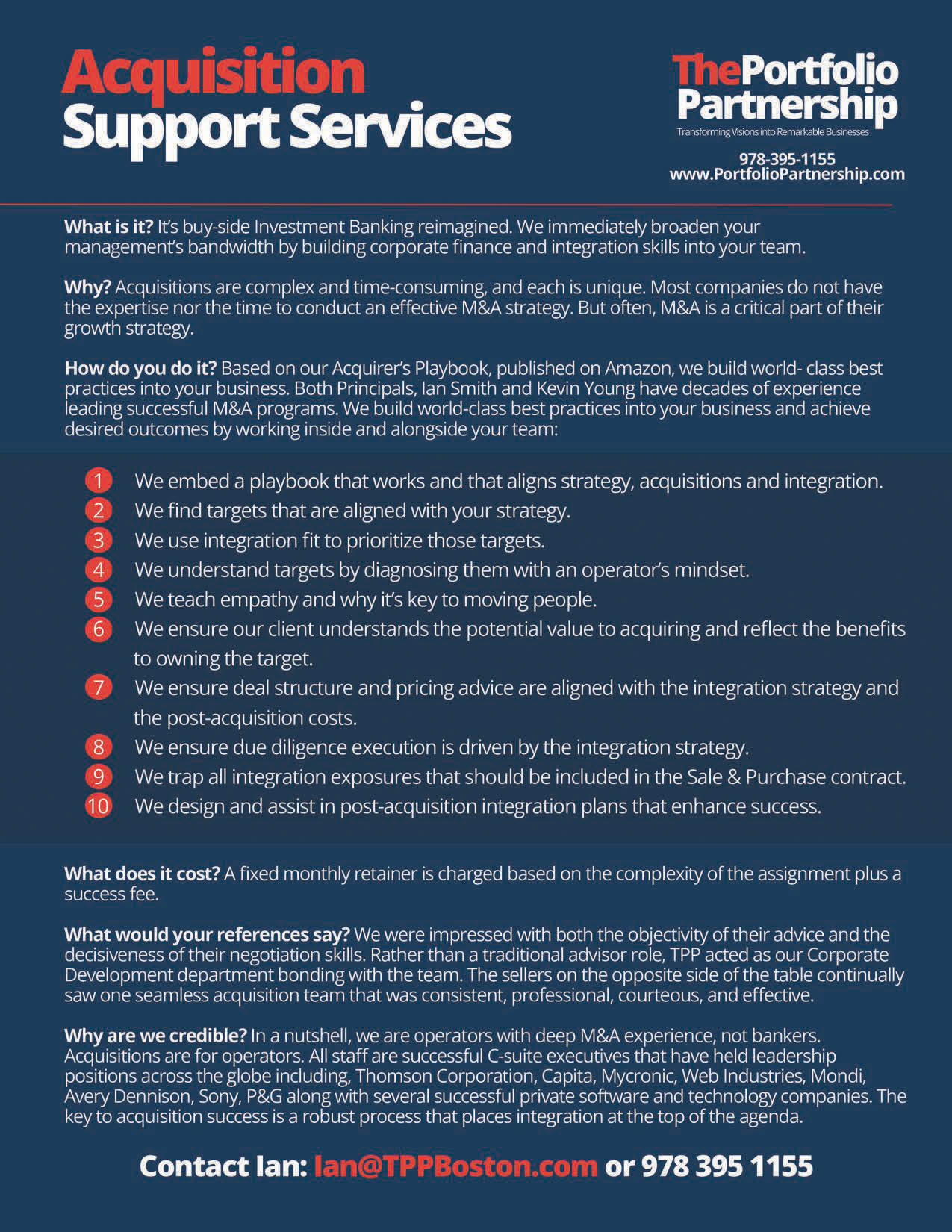
The Portfolio Partnership exists to sit in the buyer’s chair alongside the owner: scoring the 15 drivers honestly, quantifying the value gap, and deploying the operational playbooks — positioning, sales, financial rigour, talent, documented systems that close it. The promise is not a tidy report. It is transferable, de-risked, premium value, built deliberately over 18–36 months by Operating Partners and Value Accelerators who have done it before.
Our whole method is the question on the cover, asked with discipline and answered with a plan. We start with the Saleability Test. We quantify the value gap. And then we roll up our sleeves and work inside the business following signed-off 100-day plans to close it. To understand our Operating model please check out our blog post. We help you build the company you would buy, so that when the time comes, the market does too.
Ian@TPPBoston.com