Why the post-mortem may be the most undervalued stage of the acquisition process.
The company has completed its tenth acquisition. Congratulations. But is it actually any better at acquiring businesses than it was after its first?
It’s a question that doesn’t get asked often enough.
We tend to associate acquisition experience with acquisition capability. The more deals a business completes, the more proficient it must become. At least, that’s the assumption.
But the research suggests otherwise.
Experience isn’t the same as learning
In a landmark 2004 study published in the Strategic Management Journal, Maurizio Zollo and Harbir Singh examined 228 acquisitions in the U.S. banking industry.
Their conclusion was striking: accumulating acquisition experience alone did not improve performance. What mattered was the deliberate codification of knowledge — capturing lessons and translating them into processes, systems, manuals, and tools.
A subsequent study by Gates, Heimeriks, and Zollo (2006), examining 2,447 integrations across 101 companies, reinforced the importance of deliberate post-integration learning.
The distinction is important.
Completing acquisitions gives you experience. Codifying what you’ve learned builds acquisition capability.
Yet how many acquirers systematically examine what happened, why it happened, and what they should do differently next time?
That’s where the acquisition post-mortem comes in.
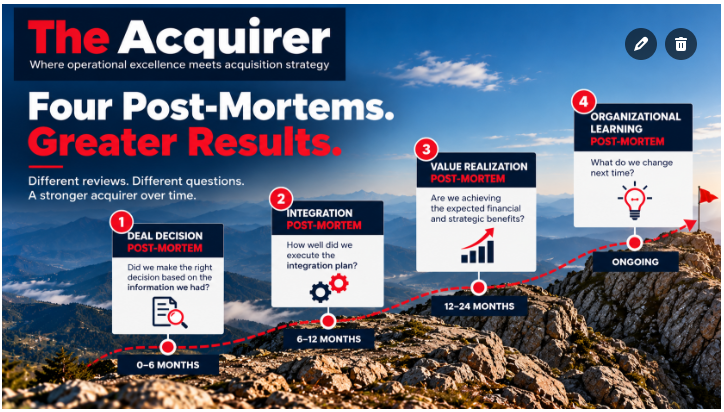
One acquisition. Four different post-mortems.
I believe there are four distinct reviews worth conducting. They answer different questions, involve different people, and should take place at different points in the acquisition journey.
1. The Transaction Post-Mortem — Did we execute the deal well?
Conducted shortly after closing, this review examines the acquisition process itself.
Did we identify and prioritize the right target? Were our valuation assumptions sound? Did due diligence uncover the important risks? Were operators sufficiently involved? Did we coordinate external advisers efficiently? Did the approval process work as intended?
And perhaps most importantly, what surprised us that shouldn’t have?
The objective isn’t to congratulate the deal team on getting the transaction across the line. It’s to improve how the next acquisition is evaluated, negotiated, and approved.
2. The Integration Post-Mortem — Did we integrate effectively?
This review should take place against meaningful integration milestones, rather than simply waiting for an arbitrary anniversary.
Did we establish clear accountability? Were the integration priorities correct? Did management have sufficient bandwidth? What happened to customers, employees, systems, and operating performance?
Were the synergies delivered, and at what cost?
Integration is where many of the assumptions made during the acquisition process meet operational reality.
3. The Investment Thesis Post-Mortem — Did we create the value we expected?
This is the review that matters most to shareholders.
Depending on the acquisition, it may take 12, 24, or even 36 months to establish whether the investment thesis has been delivered.
Did revenue, margins, cash generation, and returns meet expectations? Were the anticipated strategic benefits realized? Did we underestimate the investment required after closing?
Crucially, we should distinguish between a flawed investment thesis and poor execution of an otherwise sound thesis.
The lessons are very different.
4. The Acquisition Capability Post-Mortem — Are we becoming a better acquirer?
This is arguably the most overlooked review.
Have we improved our acquisition processes? Are our due diligence checklists better? Have we strengthened our approval gates? Is our integration playbook more effective?
Are management teams becoming more capable of executing acquisitions without external support?
Or are we still relying on the same few individuals, repeating the same mistakes, and reinventing the wheel every time?
A serial acquirer should become more capable with every acquisition, not simply more experienced.
The missing step: Codifying the lessons
Here’s the problem with many post-mortems.
Everyone gets together, discusses what went well and what didn’t, produces a list of lessons learned, and moves on.
Six months later, the next acquisition starts, and very little has changed.
A post-mortem should produce tangible improvements to the acquisition engine: revised approval criteria, better diligence questions, updated valuation assumptions, clearer integration responsibilities, and stronger operating procedures.
Every lesson should have an owner, an action, and a place in the acquisition process where the improvement will be embedded.
Otherwise, the knowledge remains in people’s heads — and may walk out the door when they do.
The Operator’s Test
Before starting your next acquisition, ask yourself:
- What did we learn from our last acquisition?
- Where have we documented those lessons?
- What have we actually changed as a result?
- Who is responsible for making sure those changes stick?
- How will we know whether we’re getting better?
If the answers are unclear, you may have accumulated acquisition experience without building acquisition capability.
The bottom line
It’s not how many acquisitions you complete. It’s how much you learn from each one — and what you do differently next time.
Experience matters. But deliberate learning, captured and embedded in the way an organization operates, is what turns experience into capability.
The real value of a post-mortem isn’t the lessons identified. It’s the changes institutionalized before the next acquisition.
Serial acquirers do more deals.
Master acquirers get better at doing them.
Reach out for a chat Ian@TPPBoston.
Research referenced
Zollo, M., and Singh, H. (2004). Deliberate Learning in Corporate Acquisitions: Post-Acquisition Strategies and Integration Capability in U.S. Bank Mergers. Strategic Management Journal, 25(13), 1233–1256.
Gates, S., Heimeriks, K. H., and Zollo, M. (2006). Building M&A Integration Capabilities: How Serial Acquirers Become Master Acquirers.