
The psychology, structure, and negotiation of a successful earn-out.
Earn-outs are a familiar feature of acquisition negotiations. Too often, they are presented as a convenient way to bridge the gap between what a seller wants and what a buyer is prepared to pay. But that’s a dangerous starting point.
An earn-out should not be a mechanism for paying the seller a valuation the business cannot justify today. Additional consideration should be earned through demonstrably higher future performance that creates additional economic value for the buyer.
The first principle is simple: pay for the business that exists today. Pay more if it performs better tomorrow.
What looks like an elegant financial arrangement at the negotiating table can become a source of mistrust, conflicting incentives, and operational frustration after completion. And that brings us to the psychology.
The Psychology: Two Parties, Two Interpretations
Imagine a business valued at $8 million based on its current sustainable earnings. The seller believes it can deliver substantially higher profits and wants $12 million. The buyer agrees to pay $8 million, with up to $4 million of additional consideration if clearly defined performance targets are achieved.
On paper, that looks reasonable. But listen carefully to how each party describes the transaction.
The seller says, “I’ve sold my business for $12 million, with $4 million coming later.”
The buyer says, “I’ve paid $8 million. I’ll pay more if the business earns it.”
Both may leave the negotiating table satisfied. Yet they have fundamentally different expectations. Three psychological forces can make this difficult.
Loss aversion. If the seller mentally treats the earn-out as money already secured, any threat to payment can feel like a loss rather than an unrealized opportunity.
Control. Entrepreneurs are accustomed to making decisions. After completion, they may remain accountable for performance while losing authority over investment, staffing, pricing, and strategy.
Fairness and trust. A legitimate buyer decision can look very different through the seller’s eyes when it reduces the likelihood of receiving additional consideration.
The result? A financial arrangement intended to align interests can create precisely the opposite behavior.
Operator Insight: Financial alignment does not automatically create behavioral alignment.
Structure: What Does a Good Earn-Out Actually Look Like?
A well-designed earn-out starts with the business’s current performance and the value already reflected in the purchase price. Only then should buyer and seller consider what additional performance would justify further consideration.
Let’s take an example. A target business generates sustainable EBITDA of $3 million. The seller aspires to an exit valuation of $27 million, representing a multiple of 9× EBITDA. The buyer believes the business is worth $21 million, representing 7× EBITDA.
Rather than simply splitting the difference, the parties agree an earn-out based on performance above the existing $3 million EBITDA baseline.
The proposed formula: 8 × (average annual EBITDA over the next two financial years, less $3 million).
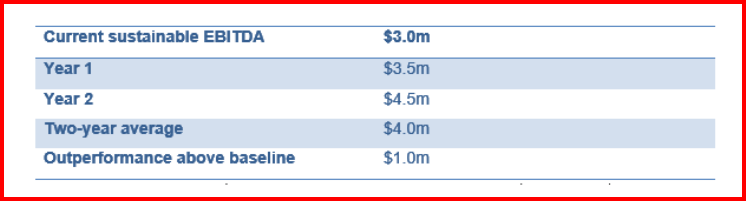
The earn-out is therefore $8 million. Total consideration becomes $29 million: $21 million paid at completion plus $8 million contingent consideration.
The seller receives more than the original $27 million aspiration. The buyer acquires a business now generating $4.5 million of EBITDA for total consideration equivalent to approximately 6.4× the final year’s earnings, compared with the original 7× entry multiple.
That’s the type of earn-out psychology that can work. The seller has been rewarded for genuine outperformance. The buyer has paid more, but for a better-performing business.
Of course, the buyer must still assess the quality and sustainability of those earnings, cash generation, and the investment required to achieve them.
A good earn-out also needs an appropriate timeframe. My preference is to keep the period to no more than two years wherever practical. Longer arrangements increase the risk that the seller becomes exposed to circumstances and operating decisions outside their control.
And crucially, the structure must be tested against the Post-Acquisition Integration Plan before signing.
When NOT to Use an Earn-Out
Sometimes the best earn-out is no earn-out at all. Before introducing contingent consideration, consider five warning signs.
The seller simply wants a higher price. A higher aspiration is not evidence of higher value. Additional consideration must be earned through additional performance.
The buyer intends significant integration. Restructuring, consolidation, systems changes, and new management may make the original performance assumptions unworkable.
The seller cannot influence the outcome. It becomes problematic when the seller bears the financial consequences of decisions entirely controlled by the buyer.
Performance cannot be measured independently. Shared customers, employees, revenues, and costs can make the calculation contentious.
The incentives encourage the wrong behavior. If the earn-out rewards deferred investment or resistance to integration, it undermines the acquisition thesis.
Operator Tip: Ask the operating team: If we didn’t have an earn-out, would we run this business differently? If the answer is yes, understand why before proceeding.
Sometimes a seller note, fixed deferred consideration, or a different upfront price is more appropriate. These alternatives address different issues and carry different risks.
The Negotiation Agenda: Agree the Rules Before Signing
Earn-outs are frequently negotiated by dealmakers, financial advisers, and lawyers. All have important roles. But the people who will actually operate the acquired business must help determine whether the arrangement is workable. And the agreed rules need to be properly documented in the Sale and Purchase Agreement.
1. What exactly triggers payment? Agree the performance metrics, thresholds, calculation methodology, caps, and payment dates. Model exceptional, modest, and disappointing outcomes before signing.
2. Who controls operating decisions? Specify authority over hiring, capital expenditure, pricing, customer transfers, and restructuring. Match accountability for performance with the ability to influence it.
3. How will accounting policies be handled? Agree the treatment of revenue recognition, provisions, exceptional items, depreciation, and changes in accounting policies. The buyer should not be able to change the measurement rules unilaterally after completion.
4. How will integration affect performance? Agree how new management, centralized functions, technology investment, and restructuring costs will be treated. These decisions may create long-term value while reducing short-term reported earnings.
5. How will costs and synergies be allocated? Address management charges, shared services, financing costs, intercompany transactions, and benefits generated through the buyer’s network.
6. What happens when circumstances change? Discuss customer losses, market disruption, founder departure, and changes in strategic direction. Not every scenario can be anticipated, but the principles for dealing with material changes should be agreed.
7. How will performance be reported and disputes resolved? Establish reporting frequency, information rights, escalation procedures, and independent determination mechanisms.
The negotiation agenda must address how the business will be operated, not simply how the earn-out will be calculated.
Operator Tips: Five Ways to Avoid an Earn-Out Disaster
1. Model the earn-out alongside the integration plan. Quantify how new management, systems investment, restructuring, and commercial initiatives will affect the earn-out before signing. Don’t assume the financial model and operating plan are compatible. Prove it.
2. Negotiate difficult scenarios while everyone is still friends. Discuss missed targets, delayed investment, and performance attributable to buyer-led acquisitions. The best time to resolve potential disagreements is before they become disputes.
3. Watch for unintended incentives. An EBITDA-based earn-out might encourage delayed recruitment, reduced marketing, deferred maintenance, or resistance to investment. Ask what someone could do to maximize the earn-out while damaging long-term value.
4. Match accountability with authority. Define decision rights, consultation requirements, and appropriate adjustments. Don’t hold the seller accountable for outcomes they cannot influence, but don’t give them an unreasonable veto over necessary integration decisions.
5. Never let the earn-out become the strategy. If management starts delaying necessary changes merely to protect the earn-out calculation, the structure is working against the acquisition. The earn-out must support the acquisition thesis, not the other way around.
Before You Sign: The Ultimate Stress Test
Put the buyer, seller, CFO, and operating leadership around the same table. Walk through the first twelve months after completion, including planned investments, leadership changes, integration priorities, and financial targets.
- Can the seller genuinely achieve the earn-out under the operating model we intend to implement?
- Will the behaviors encouraged by the earn-out make the combined business more valuable?
- If performance falls short, will both parties believe the outcome was determined fairly?
If you cannot answer those questions confidently, the earn-out probably isn’t ready to be signed.
The Bottom Line
Earn-outs have their place. They can reward sellers who help deliver genuinely superior performance and allow buyers to pay additional consideration when additional value has been created. But they are not a substitute for agreeing what a business is worth today. And they are certainly not just a financial formula to hand to the lawyers.
They are operating arrangements with profound psychological consequences.
Don’t use an earn-out to get the deal over the line. Design it to make the business more valuable after the line has been crossed.
Start a conversation with Ian – Ian@TPPBoston.com