
I’ll be writing on the LInkedIn platform going forward on a weekly basis so please sign up for my newsletter over there!
AI isn’t going to make you a successful acquirer.
But it can make a successful acquirer significantly better.
The best acquisition teams combine strategy, judgment, operating experience and disciplined execution. AI doesn’t replace any of those things. What it does is dramatically increase the amount of information those teams can process, the speed at which they can process it, and their ability to carry knowledge from one stage of an acquisition into the next.
That’s important because acquisitions are information-intensive exercises. They are for Operators.
Every acquisition generates enormous amounts of data: market research, target information, management meeting notes, financial models, customer data, due diligence reports, legal documents, integration plans and hundreds of decisions.
Historically, much of that information has sat in different spreadsheets, presentations, data rooms, emails and people’s heads.
AI changes that.
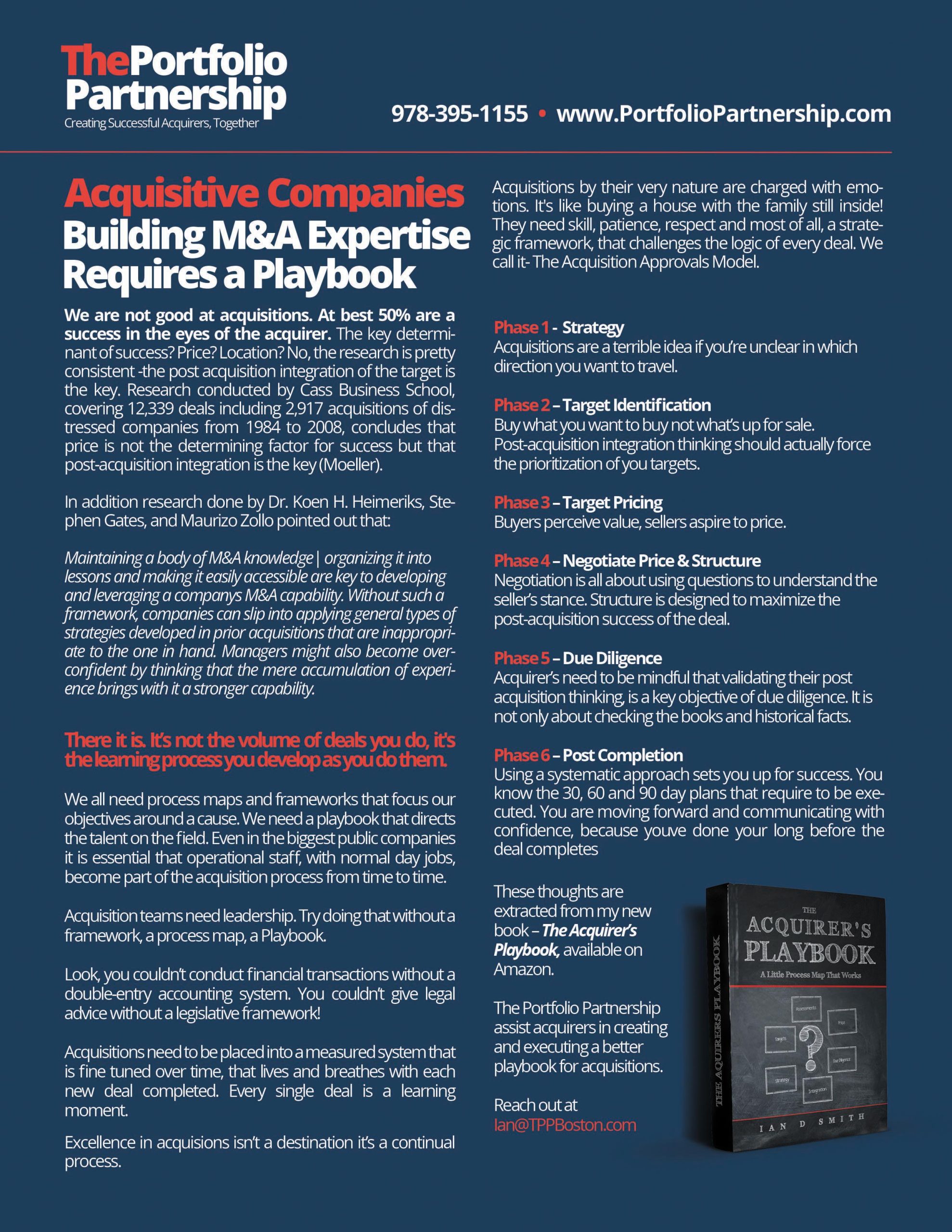
Let’s look at our six-phase Acquisition Process and where I believe AI can make the biggest difference.
Phase 1 — Strategy
Successful acquisition programs start with strategy, not targets.
You need to understand where the business is going, what capabilities it needs, where organic growth may be insufficient and exactly how acquisitions could accelerate the strategy.
That ultimately leads to a clearly defined Acquisition Profile.
AI can dramatically improve the research supporting this process.
It can analyze markets, competitors, technologies, customer needs and industry developments at a scale that would previously have required significant research resources.
More importantly, it can help management challenge its own assumptions.
What capabilities are we missing?
Which markets are changing fastest?
Where are competitors investing?
What could we build organically and what might be better acquired?
The output shouldn’t be an AI-generated acquisition strategy.
Management owns the strategy. AI makes management better informed.
Phase 2 — Identify & Assess Targets
Once you know what you’re looking for, you need to find it.
Traditionally, this can involve weeks of research building long lists of companies and manually reviewing websites, databases, industry reports and other sources.
AI can dramatically accelerate that process.
A well-designed system can examine hundreds or thousands of companies against the criteria contained in your Acquisition Profile. Next step is to build that criteria into a filtered scorecard.
Let AI score those targets based on:
-
product and service fit
-
geographic alignment
-
customer overlap
-
ownership
-
size
-
capabilities
-
market positioning
-
potential strategic fit
-
ease of integration
And it’s worth noting in our experience, that last one is ignored by 90% of acquirers until it’s too late. This ia a page 3 issue not page 23!
But there is an important caveat to using AI to score.
AI can find information incredibly quickly. That doesn’t mean everything it finds is correct.
The acquirer’s job moves from gathering information to validating, interpreting and acting on it.
Phase 3 — Target Meetings & Valuation
This is where acquisitions start becoming real.
The preparation now possible prior to the first contact with a preferred target is quite breathtaking. The opportunity to create a great first impression is huge.
As meetings with owners and management teams progress, you’re accumulating financial information, operational information, meeting notes, market research, customer information and answers to hundreds of questions.
The challenge isn’t simply storing that information.
It’s connecting it.
AI can help build a continuously evolving picture of the target:
What have we learned?
What assumptions have changed?
Where are the inconsistencies?
What questions remain unanswered?
How would this business actually operate under our ownership?
That last question is critical.
I’ve always believed experienced acquirers begin integrating a company in their heads long before they own it.
AI gives us another tool for doing that.
It can help model different operating scenarios, identify potential synergies and challenge the assumptions underpinning valuation.
That should lead to a much better understanding of something buyers often overlook:
the value of the target to us—not simply its theoretical market value.
And underpinning that value is the proposed integration strategy. That’s why you should be validating your integration strategy in almost every meeting prior to forming a view of value.
Phase 4 — Negotiation of Price & Structure
Negotiations are won long before people enter the room.
Preparation matters.
Before an important negotiation, particularly around a Letter of Intent, the acquisition team needs to understand everything it has learned about the seller, the business and the transaction.
AI can act almost like an institutional memory.
It can summarize previous meetings, identify unresolved issues, retrieve supporting evidence and model alternative deal structures.
What risks have been exposed so far?
What if working capital is lower than assumed?
Which issues matter most to the seller?
Where have their positions changed during discussions?
What are our walk-away points?
AI can make that preparation extraordinarily powerful.
But negotiation remains fundamentally human.
Understanding motivation, reading a room, knowing when to push and when to stop are judgment calls.
AI can prepare the negotiator. It shouldn’t become the negotiator.
Phase 5 — Due Diligence & Legal Agreements
This is perhaps the most obvious application.
Due diligence involves huge volumes of documents and very limited time.
It’s often a missed opportunity to validate the post-acquisition integration strategy. No longer! It is vital that integration plans are stress tested.
AI can help review, classify, summarize and cross-reference information across financial, commercial, operational and legal workstreams.
More importantly, it can identify anomalies and inconsistencies for humans to investigate.
For example:
A customer concentration number in one report doesn’t reconcile with another.
A management statement conflicts with information in the data room.
A contractual obligation could affect the integration plan.
An assumption in the valuation model hasn’t actually been validated during diligence.
The objective isn’t to replace accountants, lawyers or experienced operators.
It’s to allow those people to spend less time searching for information and more time exercising judgment.
Phase 6 — Post-Acquisition Integration
This may ultimately be AI’s most valuable contribution.
Why?
Because enormous amounts of knowledge are accumulated during an acquisition—and too much of it gets lost at closing.
The people responsible for integration frequently weren’t involved in every stage of due diligence.
Reports get filed away.
Assumptions disappear.
Commitments made during negotiations aren’t communicated.
AI gives us the potential to create a living institutional memory of the acquisition.
It gives the opportunity to set up The Integration Management Office (IMO) for success.
A finding identified during commercial due diligence can automatically inform an integration workstream.
A customer risk identified before closing can become a Day One action.
A synergy included in the investment case can be tracked against actual delivery.
Lessons from one acquisition can be incorporated into the playbook for the next.
Over time, something even more valuable happens.
The Acquirer Learns.
Instead of the acquisition capability residing in the heads of a handful of experienced executives, knowledge accumulates inside the Acquisition Operating Model.
The post-mortem review now has real teeth. Note research by Zollo, Heimeriks and Gates stated so eloquently: “Maintaining a body of M&A knowledge, organizing it into lessons and making it easily accessible are key to developing and leveraging a company’s M&A capability. Without such a framework, companies can slip into applying general types of strategies developed in prior acquisitions that are inappropriate to the one at hand. Managers might also become overconfident by thinking that the mere accumulation of experience brings with it a stronger capability”.
Every acquisition makes the next acquisition better.
The Real Opportunity
I don’t think the biggest impact of AI on acquisitions will simply be doing today’s work faster.
It will be creating better institutional acquisition capability.
Imagine an acquisition platform that remembers every target you’ve assessed, every assumption you’ve made, every diligence issue you’ve discovered, every integration decision you’ve taken and every lesson you’ve learned.
Now combine that intelligence with an experienced management team and a disciplined acquisition process.
That’s powerful.
But there is an important qualification.
AI cannot compensate for a poor acquisition process.
Automating a bad process simply allows you to make mistakes faster.
Strategy still matters.
Judgment still matters.
Operating experience still matters.
And leadership still matters.
The winners will be companies that combine those capabilities with AI to identify better targets, make better decisions, execute transactions more efficiently, reduce risk and integrate businesses more successfully.
AI won’t replace successful acquirers.
Successful acquirers who use AI will have a significant advantage over those who don’t.
Questions or interested in discussing your acquisition strategy?
I’d be delighted to hear from you.
Ian D. Smith, CA Founder & Principal The Portfolio Partnership