
As promised, over the coming months we will be posting various aspects on how buyers think. What motivates an acquirer? We want to share these insights to help owners understand the aspects of a business that a serial acquirer cherishes. Too many entrepreneurs are building unsaleable businesses that barely cover payroll and have a low probability of long term survival. There’s an easier way to make money AND build a valuable business that is also a liquid asset.
Today’s focus is customer dependency.
Why build a business that just makes money but ignores the increasing risk factors that undermines long term sustainability? Building a business that buyers will love is synonymous with building a long term sustainable business.
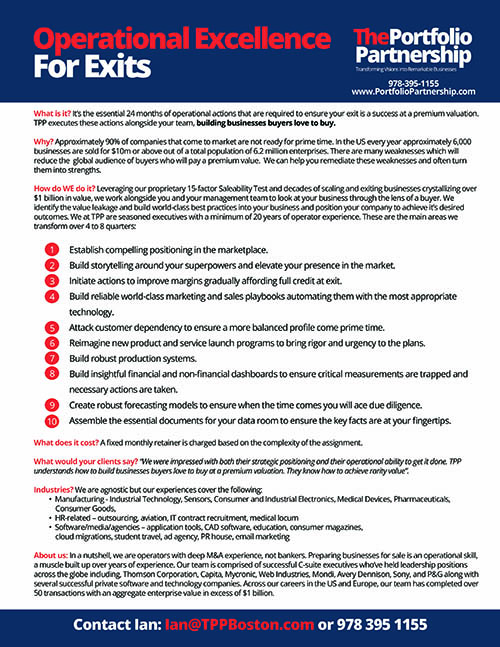
Customer Dependency
Buyers hate dependency. Dependency on the owner, one product or one customer. The post- acquisition risk is just too high. This post discusses the problem of relying on one or even a couple of customers and what you can do.
A buyer’s take:
- A buyer is myopically focused on post-acquisition risk
- Clearly reliance on a few customers is a deep concern for an acquirer. What if they fire the target company during due diligence, or post acquisition. What do I do?
- What if one of my subsidiary companies in my large group also has the same big customers and is fired by one of them. Does that put all of my services to that big customer in jeopardy?
- What if the larger customers negotiate reductions in prices. What does that do to the ROI of buying the target?
- What if these precious customers of the target don’t like me as an acquirer, for whatever reason?
Many years ago when I was advising an IT contract recruitment agency on the sale of their business, we hit this problem. I was in an investment banking role and therefore my ability to influence the operational grooming of the business (unlike now) was limited. It was a remarkable business, supplying some of the most talented programmers and project managers on the planet into various vertical segments. It had an order book going out at least six months, was hitting an annual run rate of sales of around $30m and was very profitable. The ingredients were there for a premium cash exit to a larger acquisitive group. It had one little Achilles heal, Amex accounted for 45% of revenue. It was a long term, successful relationship but the market was becoming very competitive on rates. After selecting two global acquirers from a controlled covert auction, we entered advanced negotiation and due diligence. One preferred buyer was two weeks from closing when Amex fired my client. The first buyer walked and the second buyer dropped his offer to such a low level we had to abort!
The happy ending was that two years later we sold this remarkable company for a huge premium (PE of around 18) and you can be assured there was no longer a customer dependency issue.
Lessons for Owners
So what can you do operationally to attack this problem, long before you want to sell or want the option to sell? Here are three ideas:
- Scaling a business safely starts with addressing dependency. Use that key customer to leverage new business. Build a case study using the simple but compelling formula: one page, three paragraphs, covering challenges, solution, results. Prospects respond to stories. Prospects need to imagine themselves in your story. Remember there are only two reasons sales don’t happen. Firstly, prospects don’t believe they have the problem you are solving. Secondly they don’t believe your solution works. Winning a great customer that keeps coming back for more is a great achievement, but if you want to build shareholder value, you must push on.
- Really understand the client’s client. So you have a large account with a customer that loves you. Why? What is driving your customer’s business? Those drivers are probably driving your customer’s competitors. Is your story, embedded in your marketing collateral, really articulating the outcomes you achieve, and that you know are valued. Penetrating a large account is great news, but you need to use it to develop your own business not just your customer’s business. You need to develop farming skills (mapping companies and building deep relationships across organizations) that you can deploy on other attractive prospects. You need to target some of your smaller accounts and farm!
- Use the cash flow from those big accounts to diversify your customer base and do it faster than you thought possible. Don’t rest on your laurels. What would happen if that one big customer fired you? Think of the cash flow from these large accounts as venture capital to scale the business, to help you build a stronger, well balanced sales ledger!
Entrepreneurs need courage, grit and smarts to be successful, but they need to play the long game. Scaling a business is different from growing a business. In our language we believe scaling implies sustainability, predictability and safety. We don’t believe growth implies that.
Think like a buyer and start to address value leakage issues now.
The Portfolio Partnership has been transforming businesses alongside owners to create remarkable businesses since 2010. Operating partners to SMBs.