
About the Author
A serial entrepreneur, Ian, has been successfully scaling businesses around the globe for over 40 years both organically and by acquisition. He has established himself as an astute thought leader on acquiring private companies and has completed over 40 deals with an enterprise value of $1B. Ian is a multi-company operator and an investment banker; a rare combination. The C-suite circuit gravitates towards his ability to simplify the complex. Ian has held several leadership roles at public companies: Thomson Reuters, Capita and Mycronic plus several market leading private companies. Most recently, Ian advises CEOs on building businesses buyers love to buy within his company, The Portfolio Partnership. Ian has penned many award-winning books including Fulfilling the Potential of Your Business and The Acquirer’s Playbook, both have been praised as necessary tools for industry leaders as a guide to successful acquisitions.
Our practice does two things well. We build Acquisition Programs into our client’s business alongside their team to create successful serial acquirers. We execute our Value Acceleration System preferably 2 years prior to a desired exit to transform the probability of a remarkable exit. We are operators.
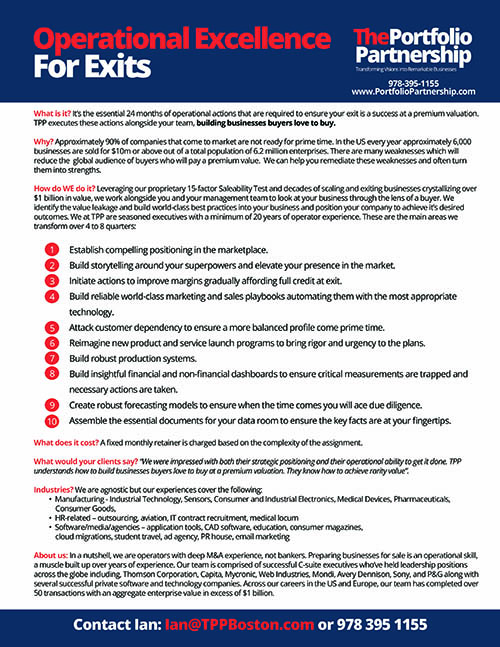



As you drive your business forward it’s easy to underestimate the power of Trigger Points.
Everyone gets so busy and distracted with noise. It might be gas prices, tariffs, personal stuff, competitor behavior, employee actions, health, or any number of things that pull you away from the key issues impacting your business.
This is where Trigger Points come into their own. These are stats or ratios that flash danger or risk as they appear on your dashboard. They need to be set up in advance and if they flash in the wrong direction, they are a call to action. A wake-up call that something needs to change. It’s worth standing back and thinking about which ones you find precious in your industry now. They need to be set up in advance, kept simple and spur action. These triggers demand attention. On investigation it might be an ant, but it might be an elephant.
Every Trigger Point needs a fixer, an accountable person that does something to run it to ground. Some triggers fall on the CEO lap, some the CFO lap, the CRO, the CMO, the production manager, the compliance manager etc. What matters is that the triggers are consistently defined, aligned with the strategic objectives, and are owned.
Here are a few for inspiration in no particular order:
▶️Book to bill – are you draining the order book quicker than you are filling it?
▶️Trailing 12s for any worthwhile stat – Revenue, Sales Leads by source. Are you declining as a trend?
▶️Gross Margin% by month below standard – do you have a recurring problem
▶️SaaS – NRR% – Growing at 110% to 120% – why not?
▶️SaaS logo churn% – What’s your leakage and why?
▶️Cash Generation% pre-funding costs – monthly trend – operationally leaking cash?
▶️Net Assets monthly trend – is your Balance sheet shrinking?
▶️Labor stats turnover – planned or surprises?
▶️Weighted pipeline % coverage to Quarterly Quota – failure of Q2 started somewhere in Q1. Ideally 150% coverage.
▶️NPS related metrics – are you triggering resolutions quickly enough, not just low scores but <9s and no responses?
▶️No response from prospects after 5 days triggers?
▶️All major projects, deadline misses?
▶️ Product volume stats by categories. Growing or declining and why?
▶️All balance sheet ratios trending over time, paying too quickly, getting paid too slowly?
▶️M&A deal flow and timing. What’s normal between each stage of your acquisition program? Set up triggers for intervention.
▶️Key targets tracked for changes. Awareness is everything.
▶️Flash figures that warn long before the finance team deliver the monthly finance pack?
▶️Productivity, utilization weekly stats in a service business that requires intervention.
▶️And of course in an AI world it might be accelerated token usage leading to a major uptime problem down the line.
Build in your triggers that allow for early intervention. It should be documented in your Operating Model under Governance which leads to Execution to keep your Strategy on track.