
As the CFO of a lower middle market business with say Revenue in the $50m to $250m, what are your trigger points that keeps the sales function honest?
In almost all industries the Book to Bill ratio is unreasonably important.
You could be in niche manufacturing, software services, construction. The ratio is striving to measure on a regular basis, say monthly, what did you close this month that adds to your order book or backlog or deferred revenue, compared with the invoiced amount during that period.
Example say your sales team closed $10m worth of orders for machines in March that will be built over the next 4 months and in March you invoiced $8m, your book to bill ratio is 1.25. This implies a growing business. You are basically filling the backlog bucket at a faster rate than you are burning it.
But this ratio can quickly go off the boil and when it does it will kill your cash generation.
If your order book is say $40m and the next few quarters you allow book to bill to drop below a ratio of 1, it doesn’t take long to drain the bucket!
Connecting these types of ratios to your sales team’s weighted forecast is crucial. Calibrating the min acceptable level of orders in a quarter to maintain a health book to bill ratio is a great example of Finance and Production and Sales working symbiotically to keep the business safe.
And a “Will We Make It” approach for the current quarter’s quota started life at least 2 quarters ago!
Build triggers into your business that gives time to react and intervene.
For added value I’m sharing our Weighted Pipeline model we use to keep sales teams focused on the prize.
We review a lot of sales processes in our work. We assess numerous CRM systems. Many sales scripts and sales moves masquerade as Sales Processes. And so many CRM systems have features you never use.
The secret to driving sales teams across the globe is to keep it simple. Give them tools they can measure their own progress. Every sales professional has a simple question to ask themselves: will I make my quota this quarter?
We are great fans of a simple process that was articulated so well in a series of books by Jeff Thull and we’ve published various blogs about it here. It revolves around a simple principle that sales folk are defined by the questions they ask. It sets out four pillars of any strong sales process: Discovery, Diagnose, Design and Deliver.
We’ve developed various versions over the years depending on the sector but the principles are clear. Selling is about improving someone’s life and nothing to do with selling stuff. To improve someone’s life you need to understand their challenges. Then translate to your product or service. If you can’t, get off the stage!
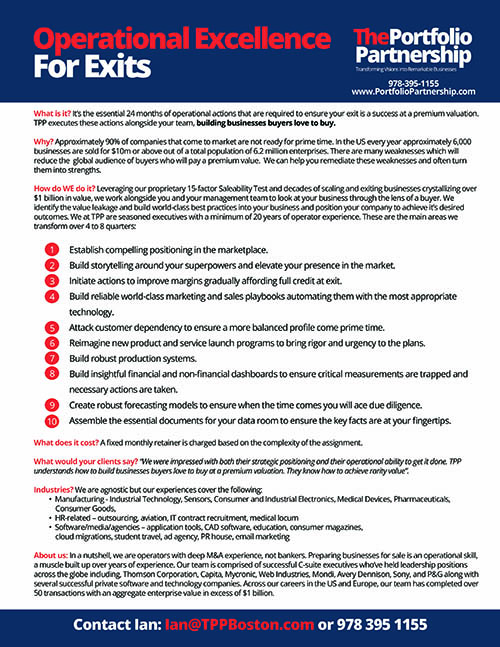
To execute this process and drive a sales team’s behavior you need a few secret weapons.
- First you need to break your sales process into phases within the 4 pillars.
- Then you need to agree exit criteria to be achieved to move to the next phase.
- By doing this, you are able to place probabilities on every phase of the process. For example early in your sales process you may allocate a low probability of 10% because key facts have not been established like budget or real pain or decision making processes or an established ROI.
- The psychology of how to partner with a prospect to move through the phases and to ensure she makes a great decision is covered in our blogs. But the key is to build great questions that uncover the status of the current situation and the consequences of taking no action. The absence of value as Jeff Thull nicely states.
- Establishing agreed probabilities with the team that everyone uses is key. That way when you pull together the weighted probability of all opportunities for every sales professional, they are all on the same basis.
Here is a simple case study from a private manufacturing company:
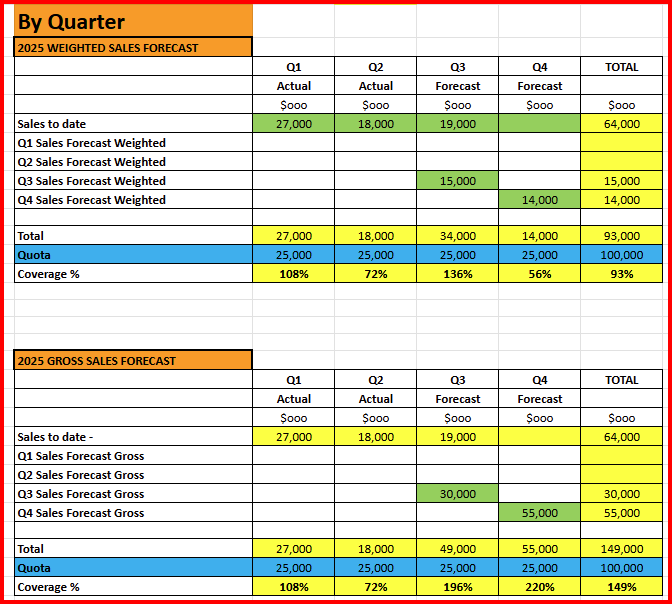
You are looking at a sales team with an annual quota of $100m. All the opportunities to date including closed sales add up to $93m or 93% of the annual quota. The gross opportunities including closed sales add up to $149m or 149% of quota.
The sales to date come from your accounting system, the weighted pipeline comes from your CRM system and now you have a simple answer to the question. Will the team make their quota? Of course this tool is also done at an individual level and/or at a regional basis. The template attached adds a cumulative look as well.
By graphing these values over time you can test the credibility of forecasts by comparing with actuals at the end of the quarter.
Benefits Summarized
- Builds a continuing calibration of forecasting accuracy.
- Links the finance team’s cash flow forecasting with a view from sales.
- It emphasizes to team members the benefit of following a robust process that’s repeatable and consistent.
- It uncovers the sales professionals who have alternative strategies to hit quota.
- It gives sales professionals a tool to run their business long before a manager steps in.
- It gives an early warning of failure as the weighted pipeline is always closer to reality than a puffed up set of gross opportunities.
- It gives marketing feedback on the quality of leads.
- Over time every company can calibrate a gold standard, e.g. in your industry a gold standard for weighted pipelines might be 200% coverage of quota!
I’m sharing the template in Google Sheets for you to copy and adjust to be helpful.
Guidance notes: Green indicates where you would link to another system. Yellow indicates a formula.
Reach out with thoughts Ian@TPPBoston.com
About the Author
A serial entrepreneur, Ian, has been successfully scaling businesses around the globe for over 40 years both organically and by acquisition. He has established himself as an astute thought leader on acquiring private companies and has completed over 40 deals with an enterprise value of $1B. Ian is a multi-company operator and an investment banker; a rare combination. The C-suite circuit gravitates towards his ability to simplify the complex. Ian has held several leadership roles at public companies: Thomson Reuters, Capita and Mycronic plus several market leading private companies. Most recently, Ian advises CEOs on building businesses buyers love to buy within his company, The Portfolio Partnership. Ian has penned many award-winning books including Fulfilling the Potential of Your Business and The Acquirer’s Playbook, both have been praised as necessary tools for industry leaders as a guide to successful acquisitions.
Our practice does two things well. We build Acquisition Programs into our client’s business alongside their team to create successful serial acquirers. We execute our Value Acceleration System preferably 2 years prior to a desired exit to transform the probability of a remarkable exit. We are operators.