
Over the coming months we will be posting various aspects on how buyers think. What motivates an acquirer? We want to share these insights to help owners understand the aspects of a business that a serial acquirer cherishes. By understanding the psychology of buyers and their methodology for assessing, valuing and integrating targets, we hope that private company owners will develop new strategies, accelerate exiting strategies or fine tune the way they run their business to build shareholder value quicker and with purpose. Too many entrepreneurs are building unsaleable businesses that barely cover payroll and have a low probability of long term survival. There’s an easier way to make money AND build a valuable business that is also a liquid asset. Don’t fall into the trap of spreading your entrepreneurial talent too thinly, focus on being remarkable at one one thing. Your strategy should look like a focused pyramid!
Why build a business that just makes money but ignores the increasing risk factors that undermines long term sustainability? Building a business that buyers will love is synonymous with building a long term sustainable business.
First Up – Positioning
An acquisition program should always be driven by a strategic rationale. What strategic gap am I fulfilling with this acquisition program? From the recent past, an aerospace client was focused on accessing Airbus by acquiring a French based supplier to Airbus based in France. Another client in the semiconductor space was committed to acquiring greater capability in the photonics space to add to their precision engineering division. Every acquirer must build a strategic case for their acquisition program. Acquirers want to buy what they want to buy not what’s up for sale. One tool they use is to build an Acquisition Profile highlighting the characteristics of the targets that fulfil their acquisition need. This is usually a global list of the top 10 targets prioritized by filters of importance e.g. location, size, technology, branding, customer base, integration ease, talent quality, competitive moat etc.
We often hear in the press about Strategic Buyers Vs Financial Buyers but we believe that’s a fallacy. All buyers are strategic especially those PE portfolio companies being being funded to extend their reach, to build a sustainable platform. Of course where the type of funding is important say between a public company and PE fund is in the potential deal structure. Owners should not expect to exit 100% when selling to a PE firm. But back to Positioning.
Lessons for Owners
- Be careful diversifying into new product or service areas outside of your expertise. Stay myopically focussed. Cargill produces $160 billion in revenue and they’re almost monomaniacal about agriculture. Big and focused or small and focused – leads to value creation and also appearing on an acquirer’s acquisition profile.
- We often see smaller private businesses (<$100m revenue) grab other small businesses which are up for sale but the strategic rationale is weak. In these cases an acquirer looks at the consolidated business and identifies many of these acquired products as non-core thus bursting the bubble of value.
- By focusing on one sliver of the universe, private company owners can be efficient with marketing dollars, staff development, playbooks and productivity improvements. Scaling leads to improved margins and a safer business.
- You start with defining your compelling story. Articulate your unique positioning. Create a memorable and inspiring boilerplate. This covers what you do and the big business results you deliver for clients supported by authentic evidence that makes your claimed results credible. Teach this boilerplate to both the marketing teams and the sales teams. Explain why it plays to the central history, DNA, culture and skill-set of your company. Make them believers. It drives everything.
- This story then drives and aligns all marketing activity. This includes all campaigns, collateral and web site copy. All focused on telling the story and designed to drive relevant prospects to the web site to read more, or to engage in conversations. Focus stories, case studies, how to use your product or service, any type of collateral on OUTCOMES. What are consequences of using your service. The consequences for specific prospects.
- Now this next piece is key. You don’t just want to create general sales prospects with your marketing campaigns you want to create specific, high quality leads. This means your story needs to be written to appeal to a specific section of the masses not the masses. If you write for the masses then you are talking to no one. If everyone is responsible for a task no one is responsible for that task.
- Create Business Results Sheets that translate the story into specific results you can achieve for customers. Separate sheet for each product or product range. These sheets need to be created with deep knowledge of the customer’s world. You want to articulate the symptoms that will be present on your customer’s site that indicate your solution is relevant e.g.
- All marketing collateral needs to articulate how the prospect could use the product in their business today. Instant gratification. Use videos, case studies, blogs, white papers, whatever it takes to make it clear how a prospect derives value from your product. So many products fail the compelling usage tests. Having great capabilities is not enough.
- Also because of their deep knowledge of the market the marketing team (heavily assisted by smart product managers) will produce excellent competitor cheat sheets highlighting why you are unique. The key is to identify the essence of your competitors and why your solution solves a problem that their solution does not or why your solution is far more compelling.
- Audit your SEO/AI results and drive strategies to improve your rankings (Use one of our partners).
- Sales Teams can now craft their engagement strategies with your unique positioning in mind. Scripts should be framed around insightful questions that demonstrate your understanding of your unique market and the issues faced by your prospects. The key for sales professionals is to find the RIGHT problems. Right means they must be a high priority and be able to be solved by you. Sales negotiations should be set up by insightful marketing literature. There should be a totally consistent narrative that supports these negotiations.
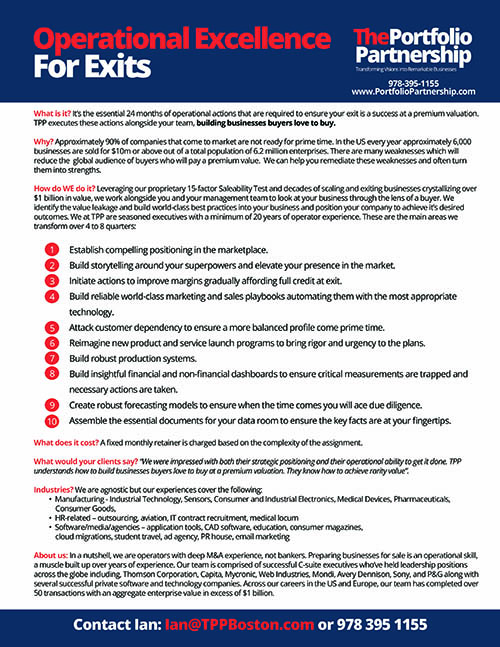
Positioning and branding are the keys to creating rarity value and it’s the first we transform when working with clients.
The Portfolio Partnership has been transforming businesses alongside owners to create remarkable businesses since 2010.
Operating partners to SMBs.