
As the owner/CEO of a private company we understand that scaling a business is hard. And everyone has a solution. Articles, blog posts, Private Equity models, Entrepreneurs’ Operating System (EOS) and more. LinkedIn is packed with the latest and greatest tricks of the trade,
Our only concern is that the resumes of those that opine are potentially light on real life experience.
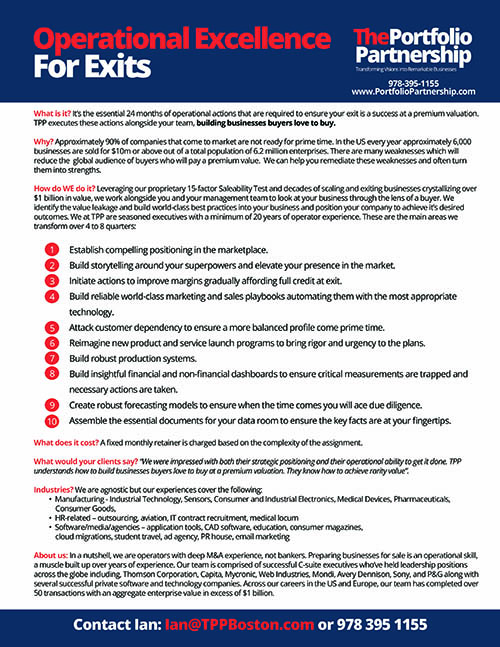
At TPP the partners have been involved in over 50 businesses in leadership roles successfully scaling to deliver attractive sustainable businesses (and of course saleable businesses when the time is right). We’ve worked across many sectors and business models including software, manufacturing, and services. We’ve touched a plethora of niches – die bonding machines, camera assembly and test systems, consumer magazines, IT recruitment, student travel, Lotus Notes application tools, material testing systems, IVF practices, Money Management firms, HR & Payroll Services, marketing agencies, FMCG, aerospace speciality manufacturing, specialized label printers, acoustic office systems. And that’s just a sample.
In our experience there are three pillars to success. It’s really quite simple. Strategy, Execution and Governance. But here is the secret sauce that makes it successful – it must be a continuous symbiotic relationship between all three. This is deceptively important. Identifying your positioning is clearly the guiding light to build your strategy. You need to know who you are, why you can win and that the market has a need that you can satisfy. Executing that strategy with care and precision will lead to success, but only if you are measuring, governing, incentivising and constantly correcting what works.
Below we have shared in one place how our system works. It is conceptually quite simple but in practice requires the care and attention to detail, that few companies are able to pull off. We find it’s not a lack of courage or a lack of workrate, but a lack of focus on the right stuff. Within our framework we have developed practical tools for every stage. In the coming months we will be sharing some of our tools that you can use to develop your version of our model.
Everything starts with strategy. What’s your unique positioning? How can you win in the marketplace? Of course the story you tell needs to resonate, it needs to connect. There’s no point in being unique and no one wants to buy your service. Positioning needs to spell out how you will transform lives.
But of course as we know it’s all about execution. The little secret we’ve leaned over the years – adding the right level of governance for the size of company in question. It is so easy to suffocate a sub $50m company with long winded processes and KPIs. The model needs to respect “pace and space”. The key is to build systems that are sustainable with the current team as it grows. Execution needs to be rigorously aligned to the strategic objectives and the weaknesses identified in the strategic phase. The governance model keeps it real. Business is a contact sport and what gets measured gets done. Playbooks are only useful if they work. They need constantly tweaking to stay relevant. Every activity your team performs should sit comfortably within the three pillars of Strategy, Execution and Governance and the interplay between them. Simplify the noise.
This is the summary version:

STRATEGY FIRST
We would suggest as you consider this model that it must start with Strategy. Wherever you are on your path to success, we recommend standing back and considering some key questions surrounding your direction and your priorities. To clarify, these are the questions we dig into followed by the tools we recommend.
QUESTIONS
- What is your reason to exist?
- How can you define and dominate your sector?
- Is your story resonating with customers, employees, investors?
- What is your competitive moat?
- What do you do better than anyone else?
- Where is the pain in your marketplace?
- Where is the market going?
- What are the strategies of serial acquirers?
- Does your product roadmap reflect market needs?
- How does dependency hinder your business?
- Is your business dependent on the owner, legacy products, key customers, the cycles of specific sectors?
- Do you have a succession plan for senior management?
- Is your talent being developed?
- Is your pricing policy economically viable?
- Do you understand product and service profitability?
- Is your governance model really measuring the right stuff?
- Are you measuring your performance relative to your competitors? Growth, profits, value propositions need to be compared with the competition?
- Are all major processes documented with accountability in place? Every process from finance through marketing and sales needs a repeatable playbook.
- Are you assessing risk and developing mitigation strategies?
- Is your balance sheet fit for scaling?
TOOLS
The main tools within the strategy pillar that deliver the greatest success include:
- A brand and positioning review assessing where you really stand in the market including customer interviews.
- An M&A landscape analysis, assessing who is buying what and why.
- The Saleability Test. Look at your business through the lens of a buyer. Assess the 15 criteria that a buyer cherishes. This uncovers value leakage and helps define the weaknesses that are killing you and your operational priorities.
- These tools feed nicely into a Strategic Planning Process – a deep dive into your markets, your relative position in that market and your ability to respond to various futures (scenario planning). Once the research is done, we recommend a strategic offsite with key Position Papers sent in advance, an agenda and a timetable, chaired by an outside facilitator. The output is a strategic plan and blueprint that drives execution and sets up the right level of governance.
We will cover these tools in more detail in future posts. I hope this helps put a framework around all of your activities.
Look out for some Zoom workshops coming up in the fall covering our tools and how we are working with ambitious management teams to transform value. Email me if you are interested in joining us.
Always available for a chat at Ian@TPPBoston.com. Current strategic focus – Private company owners looking to scale to enterprise values > $50m within the next 2 years.